Running a Singapore headquarter without a clear compliance workflow is a risk many founders underestimate. IRAS (Inland Revenue Authority of Singapore) enforces strict annual filing requirements, and the assumption that cloud accounting software handles everything automatically is one of the most common and costly mistakes growing companies make. Estimated Chargeable Income (ECI) deadlines, Form C-S submissions, and GST return accuracy all demand more than a subscription to a digital tool.
This guide walks through the specific obligations, the right technology stack, and the professional oversight that Singapore-registered companies need to stay fully compliant and financially sound.
Table of Contents
-
Why Singapore is a preferred headquarters jurisdiction
-
Singapore headquarters: Structure and compliance basics
-
Digital compliance: The cloud accounting advantage
-
Managed services vs. pure software: Finding the right fit
-
GST/VAT compliance: Integrations and practical tools
-
Avoiding penalties: Compliance program essentials for Singapore HQs
-
Why automation alone isn’t enough for Singapore HQs
-
Get expert support for your Singapore headquarter
-
Frequently asked questions
Key Takeaways
| Point | Details |
|---|---|
| Dual-filing is mandatory | Singapore companies must file both ECI and Form C-S/Form C every year, regardless of digital capability. |
| Cloud tools boost accuracy | Eligible accounting software, when set up correctly, automates IRAS filings and reduces error risk. |
| Managed services ensure oversight | Combining automation with expert review helps companies avoid costly compliance mistakes. |
| GST requires digital readiness | Properly mapped GST codes and integrated workflows are essential for seamless quarterly filings. |
| Penalties are significant | Non-compliance with IRAS deadlines can result in fines up to S$5,000 per offense. |
Why Singapore is a preferred headquarters jurisdiction
Singapore consistently ranks among Asia’s most attractive jurisdictions for a regional or global headquarters, and the reasons are concrete. The headline corporate tax rate is 17%, with partial tax exemption and the Start-Up Tax Exemption bringing the effective rate meaningfully lower for qualifying SMEs in their early years. There is no capital gains tax, no withholding tax on dividends, and a network of more than 90 Avoidance of Double Taxation Agreements that reduces friction for income flowing across ASEAN and beyond.
Strategically, Singapore is a practical gateway to ASEAN’s 600-million-person consumer market, with time-zone overlap that supports same-day coordination with both Asia and Europe. English as the working language, a deep multilingual talent pool, and strong digital and logistics infrastructure make it operationally easier to run a regional team from Singapore than from most alternatives in the region.
The regulatory environment closes the case. Incorporation is typically completed within one to three days, 100% foreign ownership is permitted across most sectors, and ACRA, IRAS, and MAS are known for transparent, predictable rule-making. These advantages are real, but the same transparency that makes Singapore easy to operate in also makes compliance lapses easy to detect.
Singapore headquarters: Structure and compliance basics
A Singapore headquarter, for compliance purposes, refers to any company incorporated or registered in Singapore that serves as the primary operational and legal entity, whether it manages regional operations or operates solely within the city-state. These companies carry full corporate income tax obligations under the Income Tax Act, regardless of their size or revenue stage.
IRAS requires all Singapore-incorporated companies to meet two distinct annual filing obligations. First, companies must submit their ECI within 3 months of their financial year-end. Second, they must file either Form C-S, Form C-S (Lite), or Form C by 30 November each year. These are separate requirements, not interchangeable steps.
| Filing | Who it applies to | Deadline |
|---|---|---|
| Estimated Chargeable Income (ECI) | All companies (unless waiver applies) | Within 3 months of financial year-end |
| Form C-S | Companies with revenue up to S$5 million | 30 November annually |
| Form C-S (Lite) | Companies with revenue up to S$200,000 | 30 November annually |
| Form C | Companies that do not qualify for C-S | 30 November annually |
Many startups incorrectly believe that obtaining an ECI waiver removes all near-term filing obligations. It does not. The ECI waiver exemption (annual revenue ≤ S$5M and ECI is nil for the YA) only applies to the ECI submission itself. Form C-S or Form C remains mandatory regardless of waiver status. This distinction catches many founders off guard, particularly in the first two years of operations.
Key compliance obligations for Singapore headquarters include:
-
Maintaining proper accounting records in accordance with the Companies Act
-
Filing ECI via myTax Portal using Corppass authorization
-
Submitting the correct Form C variant based on annual revenue thresholds
-
Registering for GST if taxable turnover exceeds S$1 million in a 12-month period
-
Retaining supporting financial documents for at least five years
Understanding your Singapore corporate tax obligations from the first year of incorporation prevents the kind of structural errors that compound over time and attract IRAS scrutiny.
With the stakes for compliance clear, let’s look at what distinguishes tech-powered compliance from traditional bookkeeping.
Digital compliance: The cloud accounting advantage
Cloud accounting platforms have transformed how Singapore SMEs manage their day-to-day financial records. Tools like Xero and Odoo allow businesses to automate bank reconciliation, generate financial statements, and maintain audit-ready records without manual spreadsheet entry. But the compliance advantage goes further than basic bookkeeping.

IRAS introduced the #SeamlessFilingFromSoftware (#SFFS) initiative to enable direct integration between accounting software and IRAS systems. Under this program, eligible software automates Form C-S filing by pulling financial data directly from the accounting ledger and submitting it through IRAS APIs, reducing manual mapping errors and submission delays. Corppass authorization is required for the software to connect to IRAS systems on behalf of the company.
Pro Tip: Automation only works accurately when your input data is clean. Before enabling #SFFS, audit your chart of accounts and confirm that every transaction is correctly categorized. Misclassified expenses are the most common source of IRAS query letters after submission.
Your choice of cloud accounting solutions directly affects how smoothly your annual compliance cycle runs. Platforms that support IRAS integration and offer structured chart-of-accounts templates for Singapore companies reduce setup time significantly. Pairing software with AI-driven bookkeeping practices further reduces the manual effort required to maintain submission-ready records throughout the year.
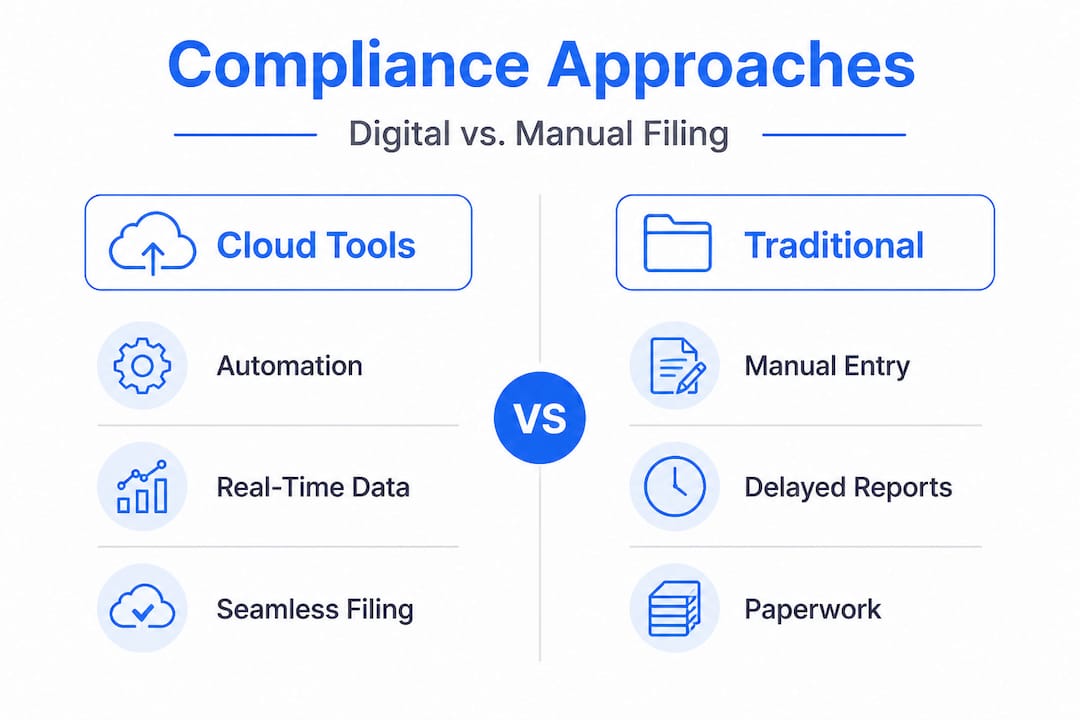
Now that you understand how digital tools streamline your workflow, it’s crucial to recognize the human factor in Singapore’s managed service approach.
Managed services vs. pure software: Finding the right fit
Not every Singapore SME has the in-house expertise to configure accounting software correctly, monitor IRAS policy updates, and review filings before submission. This is where the spectrum of managed service options becomes relevant.
The three main models available to Singapore companies are:
-
Fully managed: An external accounting firm handles all bookkeeping, tax preparation, and filing on your behalf. Best for companies without internal finance staff.
-
Automation-first: Software handles data processing and filing preparation, with minimal human involvement. Best for companies with strong internal controls and finance knowledge.
-
Hybrid: Software manages routine transactions while a professional reviews filings and handles complex compliance decisions. Best for scaling SMEs with moderate transaction volumes.
Hybrid providers in the market blend AI with managed services, offering full transaction review by in-house accountants for accuracy and compliance. This hybrid model addresses a real gap: software can automate the mechanical steps, but it cannot interpret ambiguous transactions or apply judgment when IRAS rules are updated mid-year.
Digital-first does not mean compliance-first. Penalties still apply for submission errors, regardless of whether those errors were generated by software or a human.
The right model depends on three factors: your internal finance expertise, your monthly transaction volume, and your compliance risk tolerance. A company processing 500 or more transactions per month with cross-border revenue streams has significantly more exposure than a local services firm with 50 monthly invoices.
Checklist for selecting a compliance service provider:
-
Does the provider have direct experience with IRAS filings and Singapore corporate tax?
-
Can they handle both ECI and Form C-S/Form C submissions under one engagement?
-
Do they offer Corppass setup and management support?
-
Is there a human review step before any submission is finalized?
-
Do they monitor IRAS regulatory updates and apply them proactively?
Evaluating tax compliance service models carefully before committing to a provider prevents gaps in coverage that only surface at filing time. For companies at a growth inflection point, CFO managed service options add strategic financial oversight on top of compliance execution.
Beyond income tax, GST compliance is another domain where workflow design and technology integration matter.
GST/VAT compliance: Integrations and practical tools
GST (Goods and Services Tax) compliance adds another layer of periodic obligation for Singapore companies that have crossed the S$1 million taxable turnover threshold or have voluntarily registered. GST-registered companies must file GST returns either quarterly or monthly, depending on their registration type, and submit accurate figures through myTax Portal.
The most common GST errors in Singapore SMEs stem from incorrect tax code mapping in the accounting system. When a transaction is coded to the wrong GST category, the error flows directly into the GST return, creating discrepancies that IRAS may flag during audit.
| GST code | Description | Common misuse |
|---|---|---|
| SR (Standard-Rated) | 9% GST on local taxable supplies | Applied to exempt or zero-rated supplies |
| ZR (Zero-Rated) | 0% GST on exports and international services | Used for local supplies incorrectly |
| ES (Exempt Supply) | Financial services, residential property | Confused with zero-rated supplies |
| TX (Input Tax) | GST paid on purchases | Claimed on non-claimable expenses |
Cloud accounting platforms like Xero, with third-party add-ons, provide GST-specific tooling for Singapore, supporting auto-calculation of GST returns from correctly coded transactions.
A practical GST workflow for Singapore headquarters looks like this:
-
Assign the correct GST tax code to every transaction at the point of entry.
-
Reconcile the GST control account monthly, even if you file quarterly.
-
Run a GST audit report from your accounting software before the filing deadline.
-
Cross-check the software output against your bank statements and supplier invoices.
-
Submit through myTax Portal or via integrated software before the due date.
Pro Tip: Validate all tax codes in your cloud ledger at least two weeks before every quarter-end. Catching a miscoded transaction before submission is far less costly than an IRAS amendment request or audit.
Maintaining GST bookkeeping best practices throughout the year, rather than scrambling at quarter-end, is the single most effective way to keep GST returns accurate and audit-ready.
With the integration between tax, accounting, and GST now clearer, let’s recap what most founders still overlook and how to fix it.
Avoiding penalties: Compliance program essentials for Singapore HQs
Building a structured compliance program is not optional for a Singapore headquarter. Non-filing penalties can reach S$5,000, and IRAS has the authority to pursue enforcement action, including summons to court, for repeated or willful non-compliance. Digital filing also requires active Corppass authorization, which must be maintained and updated as company officers change.
The five compliance steps no Singapore headquarter can skip:
-
Deadline management: Map all IRAS deadlines to a shared compliance calendar at the start of each financial year. Include ECI due dates, Form C-S deadlines, and GST filing periods.
-
Software setup and maintenance: Ensure your accounting software is correctly configured for Singapore tax codes, IRAS field mapping, and Corppass integration before each filing cycle.
-
GST return preparation: Reconcile GST accounts monthly and prepare returns at least two weeks before the due date to allow time for review and correction.
-
Corppass authorization: Verify that all authorized personnel and software integrations have current Corppass access. Expired or incorrect authorization prevents digital filing.
-
Pre-submission review: Assign a qualified person, whether internal or external, to review all submissions before they are finalized and sent to IRAS.
One critical point that many founders miss: an ECI waiver does not remove the obligation to file Form C-S or Form C. These are separate requirements under Singapore tax law. A company that receives an ECI waiver and then fails to file Form C-S by 30 November is still in breach of its statutory obligations.
Pro Tip: Assign a named compliance owner within your organization and set automated reminders 60, 30, and 7 days before each IRAS deadline. Compliance failures in Singapore almost always result from process gaps, not intentional non-filing.
Leveraging integrated compliance solutions that combine software automation with professional oversight closes the gap between what technology can handle and what requires human judgment.
Having walked through process, technology, and risk, it’s time for a perspective that questions common assumptions.
Why automation alone isn’t enough for Singapore HQs
There is a growing belief among Singapore startup founders that selecting the right accounting software essentially solves the compliance problem. This view is understandable but incorrect, and it creates a specific type of risk that is harder to detect than a missed deadline.
IRAS updates its rules, thresholds, and filing requirements regularly. The ECI waiver criteria, for example, are subject to change, and the distinction between ECI waiver eligibility and Form C-S obligation is precisely the kind of nuance that software does not flag proactively. A company relying entirely on automated workflows may file correctly based on last year’s rules while unknowingly violating a current-year requirement.
The principle here is straightforward: automate processes, not judgment. Software excels at executing defined rules consistently and quickly. It does not read IRAS circulars, interpret ambiguous transactions, or recognize when a business model change affects your tax classification. That requires a person with domain expertise who reviews your filings with current regulatory knowledge.
Our experience working with Singapore SMEs through finance-accounting expertise consistently shows that the companies with the cleanest compliance records are not those with the most sophisticated software. They are the ones that combine well-configured tools with a regular, structured human review cycle. The review does not need to be extensive. A quarterly check by a qualified accountant who understands Singapore’s corporate tax framework catches the edge cases that software misses.
The insider practice worth adopting: before each annual filing cycle, review the IRAS website for any updates to Form C-S requirements, ECI waiver criteria, or GST rate changes. Do not assume your software has already incorporated the latest rules. Verify it independently.
Get expert support for your Singapore headquarter
Singapore’s compliance landscape rewards companies that treat tax filing as an ongoing process rather than a once-a-year event. The right combination of cloud accounting tools and professional oversight makes that process manageable, accurate, and defensible under IRAS scrutiny.

Proseso Consulting provides tailored Singapore accounting service solutions for startups and SMEs, covering the full-cycle bookkeeping. Our team combines finance and accounting expertise with hands-on knowledge of IRAS requirements, so your filings are accurate, timely, and supported by proper documentation. For companies at a growth stage that need more than compliance execution, our CFO advisory and managed compliance services provide strategic financial guidance alongside regulatory support. Reach out to discuss a compliance program built for your specific structure and growth stage.
Frequently asked questions
What are the mandatory filings for a Singapore headquarter each year?
All Singapore-registered companies must file ECI and Form C-S or Form C-S (Lite) or Form C every year, with ECI due within three months of financial year-end and Form C-S due by 30 November.
How does #SeamlessFilingFromSoftware help with IRAS Form C-S compliance?
#SFFS automates Form C-S preparation and submission using eligible accounting software, connecting directly with IRAS systems through APIs to reduce manual entry errors and streamline the filing process.
Can my company skip Form C-S filing if we have an ECI waiver?
No. An ECI waiver does not remove the obligation to file Form C-S or its equivalent. Both requirements are separate under Singapore tax law, and missing Form C-S carries its own penalty exposure.
What is the penalty for late or non-filing of Singapore corporate income tax?
Penalties can reach S$5,000 for non-filing, and IRAS may pursue further enforcement action including court summons for repeated non-compliance.
Which cloud accounting solutions support GST preparation for Singapore SMEs?
Platforms like Xero, combined with third-party tools such as generate.TAX integration, enable Singapore SMEs to prepare IRAS-ready GST returns by auto-calculating figures from correctly coded transactions in the accounting ledger.