
Introduction: Why Hire Talents in the Philippines?
Hiring in the Philippines works when you respect two realities at the same time:
The talent market is strong: skilled, globally experienced, English-forward.
Compliance matters: labor code, government contributions, taxes, etc. Most issues come from misclassifications, weak documentation, and payroll/benefits drift over time.
I. Drafting Legally Compliant Employment Contracts
In the Philippines, a contract is not just paperwork. It’s your first compliance control. The Labor Code’s definitions matter because they affect the security of tenure, the risk of termination, and the outcome of disputes.
Employment types you’ll run into
Employment type | What it’s for | What you must get right |
Regular | Ongoing roles that are “usually necessary or desirable” to the business | Treat as long-term employment with security of tenure protections |
Probationary | Trial period before regularization | Max 6 months, and performance standards must be made known at engagement |
Project / Seasonal | Work tied to a defined project or season | The “end” must be determined at engagement; misusing this for ongoing roles is a common failure mode |
Clauses a compliant PH employment contract should cover
At a minimum, write clearly and specifically:
Role + scope: title, duties, reporting line, location (and remote-work rules)
Compensation: base pay, pay frequency, allowances, incentive structure
Working time: schedule, rest day, overtime approval process, holiday handling
Probation standards (if probationary): measurable criteria, evaluation timing, documentation
Benefits administration: SSS, PhilHealth, Pag-IBIG, 13th month pay (and how they’re processed)
Code of conduct + policies: disciplinary process, confidentiality, data privacy, IP ownership
Termination mechanics: grounds, notices, due process steps, final pay process
Why written contracts matter: when disputes happen, what wins isn’t assumptions. It’s documentation consistency across the contract, payslips, timekeeping, benefits remittances, and employee communications.
Download Proseso Consulting’s Employment Contract Template.
II. Understanding Employee Rights and Protections
This is where many foreign companies underestimate the operational burden: Philippine labor laws aren’t just written on paper, they’re also actively enforced. Issues surface through employee complaints, DOLE proceedings, and compliance gaps that often only become visible later, especially during audits or exits.
Minimum wage (by region)
Minimum wage is set by regional wage boards, so it varies by location. Don’t hardcode numbers in your offer templates without checking the latest wage order for the employee’s worksite.
Hours of work, overtime, and premium pay
Baseline norms:
The standard workday is 8 hours; the standard workweek is commonly described as up to 6 days / 48 hours in labor standards framing.
Overtime (OT) is paid at a premium (commonly framed as +25% over the hourly rate for work beyond 8 hours).
Night shift differential (NSD) is a separate premium concept under labor standards references. Generally, for work performed between 10pm to 6pm, workers are entitled to 10% additional compensation for each hour of work.
Examples of when payroll maths stops being linear (non-exhaustive):
OT on an ordinary working day: +25% of hourly rate (i.e., 125% for OT hours).
Work on a special (non-working) day: typically +30% for the first 8 hours (i.e., 130%).
Special (non-working) day that falls on the employee’s rest day: typically 150% for the first 8 hours.
Regular holiday work: 200% for the first 8 hours (and higher if it also falls on a rest day).
NSD on top of those: still applies for hours in the 10pm–6am window, which is why payroll needs the right “pay rules matrix” set up.
Sample Computations (Illustrative)
Assume:
Monthly basic pay: ₱50,000
Working days used for illustration: 261 days per year (Monday to Friday with 2 days off per week)
Standard hours: 8 hours/day
Hourly rate basis: Monthly basic pay x(12 months ÷ 261 working days ÷ 8 hours)
Item | Formula | Example |
Daily rate | ₱50,000 x 12 ÷ 261 | ₱2,298.85 |
Hourly rate | ₱2,298.85 ÷ 8 | ₱287.36 |
OT hourly rate (example: 125% multiplier) | ₱287.36 × 1.25 | ₱359.20 |
3 hours OT pay | ₱359.20 × 3 | ₱1,077.60 |
Compressed Work Schedules (Compressed Workweek)
Compressed schedules can be allowed, but DOLE guidance frames compressed workweek schemes as voluntary agreements and also calls out coverage limitations (e.g., exclusions for certain high-risk work conditions).
Rest days, holidays, and basic leaves
Rest day and holiday pay rules are part of DOLE’s statutory monetary benefits framework.
Service Incentive Leave is a standard baseline concept employers need to track properly (especially when converting unused leave to cash).
Workplace protections and baseline compliance
Foreign employers should treat these as non-negotiables:
Equal work opportunity / humane conditions are core policy anchors in Philippine labor law framing.
Workplace harassment and gender-based protections: Safe Spaces Act obligations can touch workplace policy and complaint handling.
Occupational Safety and Health requirements exist and have penalties; don’t run PH headcount without OSH controls.
IV. Employee Benefits: What Employers Must Provide
Government-mandated benefits
Benefit | What it is | What employers actually do | Basis for Computation | Computation |
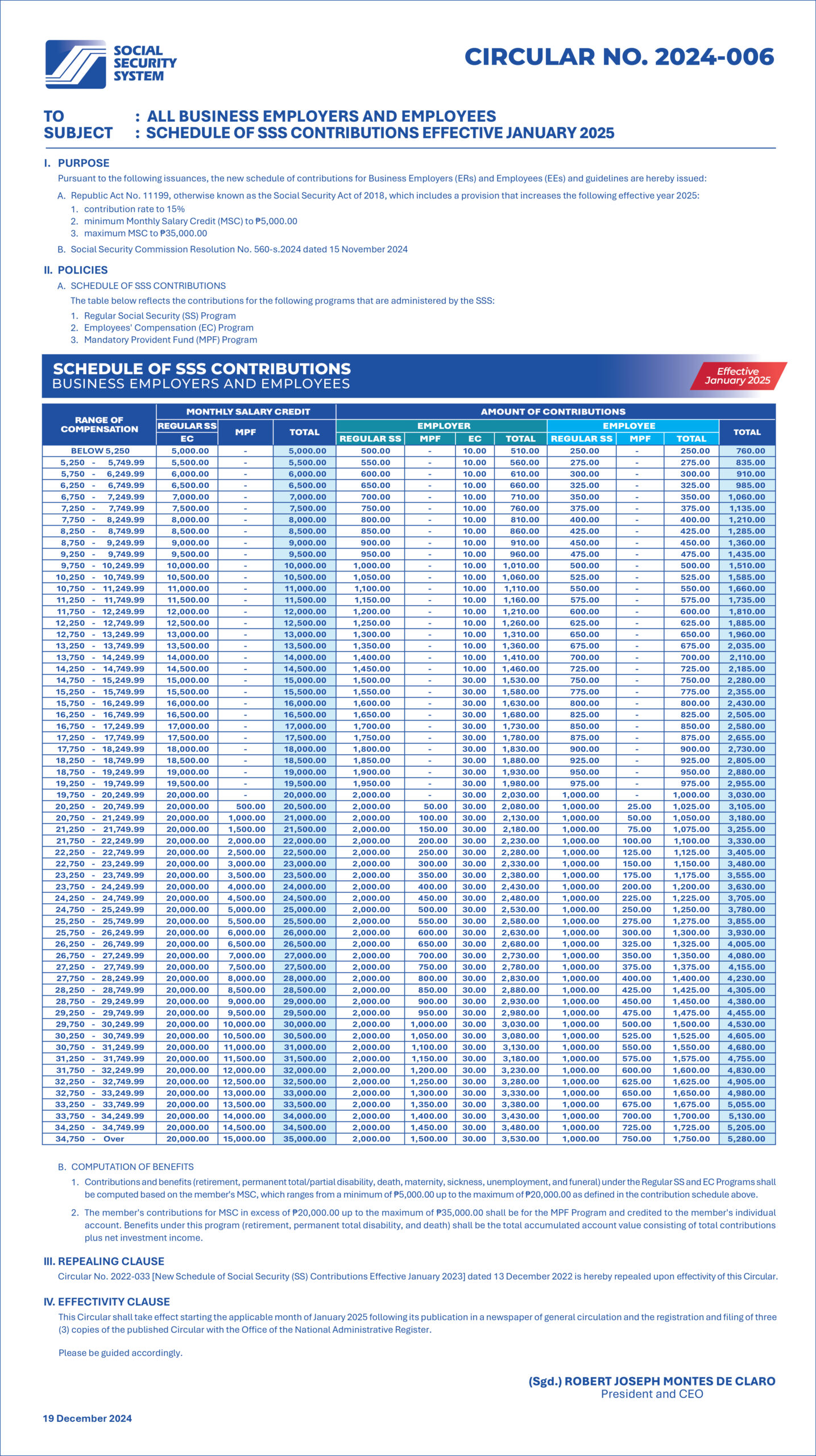
SSS | Social security (pension, disability, sickness, etc.) | Register as employer, enroll employees, remit contributions; contribution schedules are issued by SSS | Monthly salary earned (including allowances and other benefits) | Refer to Contribution Table to determine the corresponding Monthly Salary Credit (MSC), Employer and Employee Share |
PhilHealth | National health insurance | Register, remit premiums based on the current rate/floor/ceiling guidance | Monthly basic salary | 5% split between employer and employee |
Pag-IBIG (HDMF) | Housing savings fund | Register, remit contributions; HDMF issuances can adjust bases (e.g., maximum fund salary) | Monthly salary earned (including allowances and other benefits) | 2% capped at P10,000 for employer and employee |
13th Month Pay | Mandatory year-end pay concept for rank-and-file (per PD 851 framework) | Compute correctly and pay on time; DOLE references cover coverage and computation framing | Total basic salary earned during the calendar year | Total basic salary earned during the calendar year ÷ 12 |
13th Month Pay (Sample Scenario)
13th Month Pay is commonly computed as:
Total basic salary earned during the calendar year ÷ 12
Scenario | Basic salary earned | Computation | Example 13th Month Pay |
Employed full year | ₱50,000 × 12 = ₱600,000 | ₱600,000 ÷ 12 | ₱50,000.00 |
Started April 1 (9 months) | ₱50,000 × 9 = ₱450,000 | ₱450,000 ÷ 12 | ₱37,500.00 |
Worked 6.5 months | ₱50,000 × 6.5 = ₱325,000 | ₱325,000 ÷ 12 | ₱27,083.33 |
Note: “Basic salary” treatment can vary depending on pay components and classifications. Keep the example as-is, but operationally confirm what’s included in your payroll structure.
De minimis benefits (often used, not “mandatory,” but relevant)
De minimis benefits are primarily a tax treatment topic (not a labor-mandated benefit), but they matter because they shape take-home pay and payroll design. The BIR updated the non-taxable ceilings via RR No. 29-2025 (issued Dec 22, 2025), with effectivity referenced as January 6, 2026 in professional and industry guidance.
V. Ensuring Compliance with Philippine Labor Laws
Compliance isn’t one filing. It’s alignment across your contracts → payroll → timekeeping → benefits → HR process.
A practical compliance process (what good looks like)
Build compliant contract + policy scaffolding
Employment agreement + handbook + disciplinary process + harassment/OSH policies
Set up payroll and timekeeping controls
Pay schedule, payslips, OT approval flow, holiday rules, leave ledger
Register and remit statutory benefits
SSS / PhilHealth / Pag-IBIG registrations + monthly remittances
Keep a clean employee file
Contract, job description, evaluations, memos, time records, payslips, remittance proofs
Plan terminations properly
The Labor Code defines grounds and separation pay mechanics in key scenarios (redundancy/retrenchment/closure/disease), including notice expectations and separation pay formulas.
Resolving issues: DOLE conciliation / SEnA
When issues arise, the system encourages early settlement through the Single Entry Approach (SEnA), a structured conciliation-mediation process tied to DOLE guidance and later institutionalized by law.
Conclusion: Hiring Local Talent, the Road to Success
Hiring in the Philippines is a growth lever. If you treat compliance as an operating system, not a one-time setup.
The companies that stay out of trouble do at least these 2 things consistently:
They classify employment correctly (regular/probationary/project/contractor), document and follow the agreement.
They run clean payroll + remittance discipline (SSS / PhilHealth / Pag-IBIG / Withholding tax).
Proseso Consulting - Your Modern Finance Expert - For Seamless Growth in the Philippines and Singapore
With our deep local expertise and modern solutions, we enable businesses to leverage the region’s dynamic opportunities and scale with seamless, profitable growth.
Quick note: This guide shares general information, not legal advice. Labor compliance decisions affect cost, risk, and employee relations. Treat this as a starting point, then validate specifics for your situation.
Expanding smart means your payroll doesn’t break when headcount grows, teams go cross-border, or reporting gets stricter. Build the PH system now so it scales cleanly alongside your SG operations.