The Bureau of Internal Revenue’s e-invoicing mandate has quietly moved past the stage where you can afford to wait and see — if you are in scope. Every legitimate Philippine business already knows the basics of registered invoicing: manual booklets, loose-leaf with permit, or a CAS approved by BIR.
The new mandate is a different layer on top of that. It requires generating invoices as structured data and transmitting that data electronically to BIR’s Electronic Invoicing System within a defined window after each transaction. A registered manual booklet or a loose-leaf permit does not satisfy this. Neither does an older CAS that prints compliant invoices but cannot output structured data or connect to EIS. With the compliance deadline extended to December 31, 2026 via Revenue Regulations No. 26-2025, the clock is running for covered taxpayers.
This guide is written for Philippine SMEs in the first wave of the mandate — primarily those engaged in e-commerce or internet transactions (small, medium, and large; micro taxpayers are exempt), Large Taxpayers under the LTS or the Ease of Paying Taxes Act, and businesses already using a Computerized Accounting System, Computerized Books of Accounts with electronic invoicing, or other invoicing software.
If you are unsure whether you are covered, the next section clarifies the scope.
Table of Contents
-
Step 1: Assess your current invoicing process and identify gaps
-
Step 2: Options for compliance—manual upload vs. system integration
-
Step 3: Implement, transmit, and validate your electronic invoices
-
What most SMEs miss: Compliance is a system, not a template swap
-
SME e-invoicing transition: Get help from tax and automation experts
Key Takeaways
| Point | Details |
|---|---|
| Start with a gap analysis | Map your current invoicing processes against BIR’s structured e-invoice and transmission requirements. |
| Go beyond your current invoicing setup | Compliance requires sending structured invoice data electronically to BIR — a registered manual, loose-leaf, or older CAS setup is not enough on its own. |
| Manual or automated paths | Choose manual portal upload for low volume or system integration for higher invoice counts and scalable automation. |
| Treat compliance as an IT project | Implement, test, and validate all technical and process requirements in advance—don’t wait until the deadline. |
What does the BIR e-invoicing mandate actually require?
Before you can prepare, you need to understand precisely what BIR is asking for. The mandate is not about reformatting your invoices or upgrading your printed templates. It goes deeper than that.
The core requirement is the ability to generate and transmit structured invoice data to the Bureau’s Electronic Invoicing System (EIS). E-invoicing compliance is about transmitting structured invoice data to BIR for electronic sales reporting in a machine-readable format the EIS can ingest, validate, and audit automatically. A compliant manual booklet, loose-leaf invoice, or CAS-printed invoice satisfies the older registration rules under the NIRC and previous RRs, but it does not satisfy the structured-data-and-transmission requirement under RR 11-2025.
“A registered invoicing setup — manual, loose-leaf, or older CAS — is the foundation, not the finish line. BIR e-invoicing compliance adds two new obligations on top: producing structured invoice data in the required format, and transmitting it to the Electronic Invoicing System within the prescribed window.”
Who does this apply to? The first compliance wave covers e-commerce and internet transaction taxpayers (excluding micro), Large Taxpayers (LTS and EOPT classifications), and taxpayers already using a CAS or CBA with electronic invoicing. Exporters and RBEs availing of tax incentives are explicitly deferred until BIR establishes the system to receive their data, and will be covered via a separate Revenue Regulation. POS users are also in a deferred phase. SMEs outside these categories are not in the first wave, but the practical advice in this article still applies — early preparation reduces cost and disruption when later phases roll out. Waiting until Q4 2026 to start is extremely risky given the technical and operational work involved.
The table below summarizes key mandate parameters:
| Mandate element | Requirement |
|---|---|
| Invoice type | Structured data format (not PDF) |
| Transmission method | EIS Taxpayer Portal or API integration |
| Data fields required | Taxpayer details, transaction data, VAT breakdown, timestamps |
| Compliance deadline | December 31, 2026 (per RR No. 26-2025) |
| Penalty for non-compliance | Surcharges, interests, potential audit exposure |
| Record retention | 10 years (per RR 17-2013 and RR 5-2014: 5 years hard copy + 5 years electronic/microfilm) |
Non-compliance carries serious consequences. BIR can treat missing or improperly transmitted invoices as unrecorded sales, triggering audit assessments, surcharges of 25 percent under Section 248 of the NIRC (rising to 50 percent for willful neglect or false returns), plus interest at the rate prescribed under Section 249. For SMEs operating on thin margins, a single compliance gap discovered during an audit can become a significant financial liability.
Step 1: Assess your current invoicing process and identify gaps
The first practical action every SME must take is a gap analysis. This means mapping your existing invoicing process against what the BIR e-invoicing mandate actually requires. Without this step, you risk building a solution that only partially solves the problem.
A defensible SME approach is to build a gap analysis between current invoicing and the mandate’s requirement to generate and transmit structured invoice data to BIR. That analysis should cover document types, data sources, system compatibility, and whether structured data can be extracted from your existing records.
Here is a comparison table that illustrates what most Philippine SMEs discover during this exercise:
| Feature | Current state (typical SME) | Mandate requirement |
|---|---|---|
| Invoice format | Word, Excel, or PDF | Structured JSON or XML |
| Data fields | Variable, manually entered | Standardized BIR-required fields |
| Transmission method | Email or courier | EIS Portal or API submission |
| Validation | None or internal review | BIR system validation with response code |
| Archiving | Physical or cloud folder | Electronic archive with retrieval capability |
| Digital signatures | Not used | Required for authenticated transmission |
Use the following checklist to conduct your gap analysis:
-
Catalog all invoice types you currently issue: official receipts, commercial invoices, debit notes, and credit notes.
-
Identify your data sources. Does your accounting system hold the data needed for BIR’s required fields, or do staff manually key in values?
-
Check system compatibility. Can your current accounting or billing software export structured data formats such as JSON or XML?
-
Evaluate your IT infrastructure. Do you have the internal capability to configure API connections, or will this require external technical support?
-
Review your archiving practice. BIR requires electronic records to be retrievable for audit purposes. Verify that your current storage method supports this.
-
Assess your team. Which staff members handle invoicing, and do they understand the new compliance requirements?
Your bookkeeping services provider or internal finance team should be the primary driver of this analysis, but do not exclude your IT staff or system administrators. This is where many SMEs make their first mistake: treating e-invoicing as a purely accounting issue when it requires technical input from the outset. Pairing the finance review with financial advisory services can also help you scope the budget and timeline realistically.
Pro Tip: Schedule a joint session with your accounting lead and your IT or systems administrator before making any software decisions. The finance side knows what data is required; the IT side knows what your current systems can actually export. Skipping this coordination leads to costly rework later.
Step 2: Options for compliance—manual upload vs. system integration
Once you complete your gap analysis, you face a critical decision: how will your SME actually submit e-invoices to BIR? There are two operational routes available.

SMEs should expect to implement e-invoicing through one of two submission routes: manual uploading via the EIS Taxpayer Portal for low volume, or API and system integration for automation. Understanding the difference between these options is essential before you invest in any technology.
Option 1: Manual portal upload. Your staff logs into the BIR EIS Taxpayer Portal, prepares invoice data in the required format, and uploads files directly. This route requires no API development and lower upfront technical investment.
Option 2: API or system integration. Your accounting or ERP system connects directly to the BIR EIS via an API, automatically transmitting structured invoice data after each transaction or in scheduled batches. This route requires technical setup but eliminates manual intervention once configured.
The table below compares both approaches across the factors that matter most to SMEs:
| Factor | Manual portal upload | API/system integration |
|---|---|---|
| Upfront cost | Low | Medium to high |
| Ongoing workload | High (manual effort per upload) | Low (automated once set up) |
| Error risk | High (human input) | Low (system-generated data) |
| Scalability | Poor for high volumes | Excellent |
| Technical skill needed | Minimal | Moderate to advanced |
| Suitable for | Low-volume SMEs (fewer than 50 invoices per month) | Growing SMEs, e-commerce, exporters |
Key considerations when choosing your route:
-
Transaction volume is the primary factor. If your SME issues a low volume of invoices — in our experience, roughly under 50 per month — manual upload may be practical in the short term. The right threshold depends on your team’s capacity and error tolerance, not just the number itself.
-
Error tolerance matters. Manual entry introduces transcription errors that can cause BIR validation failures and require resubmission. Every failed transmission is a compliance risk.
-
Growth trajectory should inform your decision even if volume is low today. If you expect sales growth, investing in integration now avoids a disruptive migration later.
-
Staff availability is a real constraint. Manual uploading requires a dedicated team member who understands the required data format and can manage exceptions.
If you operate across Philippines and Singapore, structured bookkeeping services that align with both jurisdictions’ reporting requirements make the integration route more attractive, since a unified system can handle both markets simultaneously. For SMEs unsure about the cost and workload involved, reviewing your options with finance and accounting specialists can clarify the most efficient path.
Pro Tip: Start with manual upload if you genuinely have low transaction volume, but document your integration roadmap from day one. Revisit the decision every quarter. Many SMEs that start manual find they outgrow it within six months, and a planned migration is far less painful than an emergency one.
Step 3: Implement, transmit, and validate your electronic invoices
Implementation is where the actual work happens, and it is where most compliance projects either succeed or stall. Treat this phase as a structured IT and finance project, not an administrative task.
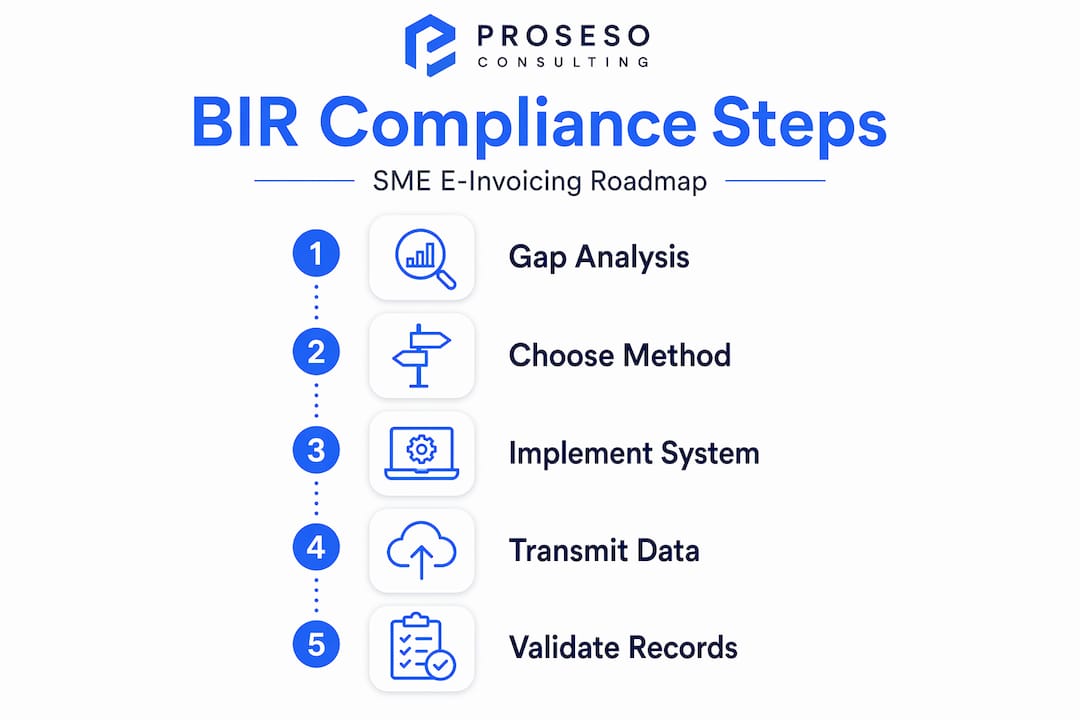
Practical SME readiness involves treating the rollout as a systems project covering data mapping, invoice template review, configuration, testing, and exception handling, not just swapping invoice layouts. That framing matters because it shifts accountability from one person to a team with clear milestones.
Follow this implementation sequence:
-
Data mapping. Identify every data field BIR requires in the structured invoice and map it to the corresponding field in your accounting system. Gaps in mapping will cause validation errors during transmission.
-
Invoice template review. Confirm that your invoice templates capture all mandatory fields: taxpayer identification number, transaction date, item description, unit price, quantity, VAT amount, and total amount due.
-
System configuration. Set up your accounting system or billing software to output structured data in the format BIR accepts. This commonly involves JSON formatting under the EIS framework.
-
Digital signature setup. BIR requires digital signatures and structured formats as part of transmitting invoices. Your system must be configured to apply a valid digital certificate to each transmitted invoice. Obtain a valid digital certificate from a BIR-recognized certificate authority. Specific accreditation guidelines and accepted certificate authorities will be detailed in separate revenue regulations to be issued by BIR — coordinate with your software vendor or compliance advisor to confirm the current accepted providers.
-
User acceptance testing (UAT). Run test transmissions using sample invoice data before going live. Verify that BIR’s EIS returns a valid acknowledgment response rather than an error code.
-
Important operational constraint: Electronic invoice data must be transmitted to BIR’s EIS within a maximum of three calendar days from the date of the transaction. Build your monitoring and exception-handling process around this window — a backlog of failed transmissions becomes a compliance issue very quickly.
-
Error handling protocol. Define what happens when a transmission fails. Who is notified? What is the resubmission timeline? How is the failure logged for audit purposes?
-
Archiving configuration. Confirm that every transmitted invoice and its corresponding BIR acknowledgment is stored in a retrievable electronic archive for the full BIR retention period — 10 years in total (5 years in original hard copy or electronic form, plus 5 additional years in electronic or microfilm form), per RR 17-2013 as amended by RR 5-2014.
Important: Issuing an invoice to your customer does not equal compliance. The invoice must also be successfully transmitted to and validated by BIR’s EIS. A failed or missing transmission is treated as non-compliant, even if the customer received their copy. Build your monitoring process around transmission confirmation, not just invoice issuance.
Maintain a transmission log that records the invoice number, transmission timestamp, BIR response code, and resolution status for any errors. This log becomes your first line of defense during a BIR audit. Supporting your compliance process with professional tax compliance services ensures that your transmission records align with your VAT and income tax filings.
What most SMEs miss: Compliance is a system, not a template swap
Here is the uncomfortable truth most guides avoid: the biggest e-invoicing compliance risk for Philippine SMEs is not technical. It is organizational. The moment an SME owner assigns e-invoicing to “accounting” or “IT” alone, the project is already fragmented.
E-invoicing readiness is a systems project covering data mapping, configuration, testing, and exception handling. That means ownership must be cross-functional. The finance team understands the tax data requirements. IT manages the system configuration and transmission. Operations or sales needs to understand how invoice generation workflows will change. Without alignment across all three, you end up with a system that technically transmits data but produces errors because the underlying business process was not redesigned.
The second issue is timing. Many Philippine SMEs will wait until Q3 or Q4 2026 to start, reasoning that the December 31 deadline is “still far.” That reasoning ignores the reality of implementation timelines. In our experience advising clients on similar BIR digital compliance projects, system configuration, testing, certificate procurement, and staff training typically require three to six months when done properly. Starting in October 2026 for a December deadline leaves almost no margin for error, rework, or vendor delays.
The third, and most overlooked, insight is that e-invoicing compliance is an opportunity to improve your invoicing process, not just a regulatory obligation. SMEs that use this mandate as a trigger to clean up their data hygiene, standardize invoice fields, and automate previously manual steps will emerge with a more efficient finance operation. Those that treat it as a checkbox exercise will likely face ongoing errors and audit exposure.
Consulting financial advisory services during the planning stage is not a luxury. It is how you avoid making expensive decisions based on incomplete understanding of BIR’s technical requirements.
SME e-invoicing transition: Get help from tax and automation experts
If working through data mapping, system configuration, digital signatures, and BIR transmission requirements feels like a significant burden on top of running your business, you are not alone.

Proseso Consulting supports Philippine SMEs through every stage of the e-invoicing compliance process. From conducting your initial gap analysis and advising on the right submission route, to configuring your accounting system and building your transmission monitoring framework, our team brings both the regulatory expertise and the technical understanding to keep your project on track. Our financial advisory services help you prioritize and budget the transition correctly, while our tax compliance services ensure your transmitted invoice data aligns with your VAT returns and income tax filings. If your finance records need strengthening before you begin, our bookkeeping services provide the clean data foundation that accurate e-invoicing depends on. Reach out to Proseso Consulting to schedule your e-invoicing readiness assessment before the 2026 deadline closes in.
Frequently asked questions
Is my SME actually covered by the December 31, 2026 deadline?
Not all SMEs are. The first wave covers e-commerce and internet transaction taxpayers (excluding micro), Large Taxpayers under the LTS or EOPT Act, and businesses using a Computerized Accounting System, Computerized Books of Accounts with electronic invoicing, or other invoicing software. Exporters, RBEs with tax incentives, and POS users are deferred to a later phase. SMEs outside these categories are not in the first wave but should still prepare, since future phases will extend the mandate.
Is generating PDF invoices enough for BIR e-invoicing compliance?
No. Neither a PDF invoice, a manual booklet, a loose-leaf invoice, nor a CAS-printed invoice satisfies the mandate on its own. Compliance requires generating structured invoice data and transmitting it to BIR’s EIS within the prescribed window.
What is the current BIR e-invoicing compliance deadline for SMEs?
The compliance deadline is December 31, 2026 per Revenue Regulations No. 26-2025, which extended the original timeline. SMEs should begin implementation well before this date to allow time for testing and error resolution.
How do I choose between manual uploading and automated system integration?
Manual uploading via the EIS Taxpayer Portal works for low-volume SMEs, but API or system integration is better suited for businesses with higher transaction volumes or those expecting growth, since it reduces manual workload and error risk significantly.
What technical elements do I need to handle for BIR e-invoicing?
Your system must produce invoice data in structured formats such as JSON, apply valid digital signatures, transmit data to BIR’s EIS, receive and log acknowledgment responses, and archive all records for the required retention period.
How long must I keep my electronic invoice records?
BIR rules require a total retention period of 10 years — 5 years in original electronic or hard-copy form, plus 5 additional years in electronic or microfilm form (RR 17-2013 as amended by RR 5-2014). Your archive must allow retrieval during a BIR audit.