
The Philippines: A World-Class Outsourcing Destination
Why Businesses Choose the Philippines
There are three kinds of withholding taxes that are vital to businesses:
Advantage | Details |
English Proficiency | Ranked #2 in Asia and #28 globally for English proficiency, with over two-thirds of the 110M+ population fluent in English. The country’s strong Western cultural affinity—rooted in its historical ties with the United States—translates into seamless communication with English-speaking clients. |
Cost Savings | Businesses typically save 50–60% on staff costs compared to Western markets. North America accounts for approximately 70% of Philippine BPO client revenue. |
Young, Educated Workforce | The Philippines produces over 800,000 college graduates each year, many in business, IT, engineering, and healthcare fields. The median age is under 26, providing a deep and growing talent pipeline. |
AI-Ready Workforce | Over 60% of Philippine BPO firms have adopted AI tools, with adoption projected to reach 85% by end of 2026. |
Expanding Service Range | Beyond traditional customer support, the industry now offers data analytics, software development, financial consulting, healthcare information management, and creative services. |
Government Support | The CREATE MORE Act (2024) provides enhanced tax incentives, while PEZA and FIRB offer fiscal benefits including income tax holidays. |
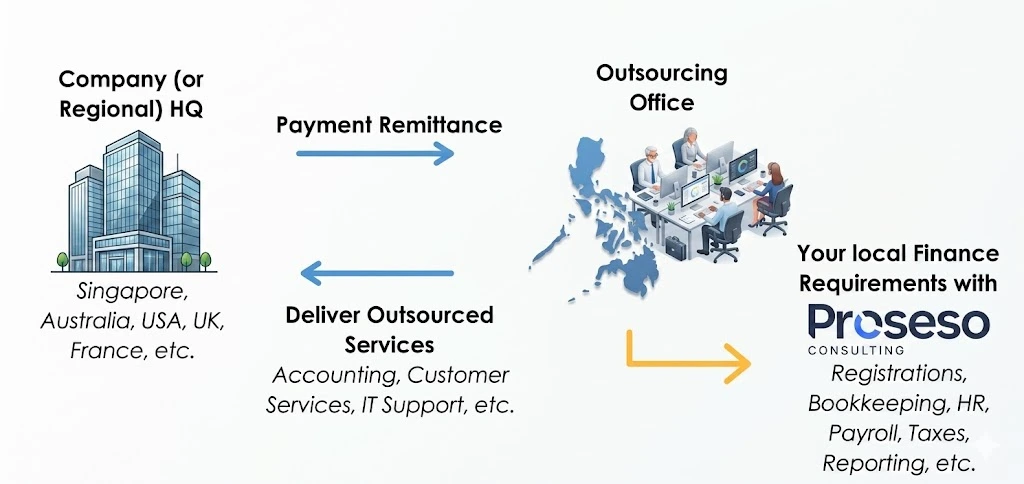
The outsourcing world uses a lot of specialized terminology—BPO, Employer Of Record (EOR), Nearshoring, Offshoring, Managed services, and so on. Throughout this guide, we use “outsourcing” as a general term simply to refer to the practice of running part of your business processes through a subsidiary or office located in the Philippines:
The AI Factor: How Technology Is Reshaping Philippine Outsourcing
AI is no longer a future trend for the Philippine BPO industry—it is today’s reality. Over 60% of Philippine BPO firms have adopted AI tools, with adoption projected to reach 85% by end of 2026 (AMRO Asia).
Rather than displacing the workforce, AI is amplifying it: Filipino agents augmented by AI achieve 85–92% first-contact resolution rates, training periods have dropped by 67%, and chatbots now handle 60–75% of routine inquiries. For businesses setting up in the Philippines, this means you’re accessing not just cost savings but an AI-mature workforce delivering operational cost reductions of around 15% on top of already competitive labor rates.
Setting Up an Outsourcing Company in the Philippines
Incorporating a company in the Philippines for outsourcing purposes is more straightforward than many business leaders expect.
Foreign Ownership Rules
While the Philippines maintains a Foreign Investment Negative List (FINL) that restricts foreign ownership in certain industries—such as mass media, cooperatives, and private security—outsourcing activities can operate with 100% foreign ownership. The 13th Regular FINL, issued under President Marcos Jr., has further liberalized several sectors including telecommunications and retail trade, signaling the government’s continued commitment to attracting foreign investment.
Capital Requirements
Under the Foreign Investments Act (R.A. 7042, as amended), 100% foreign-owned domestic market enterprises generally require a minimum paid-up capital of US$200,000 (this threshold drops to US$100,000 if the company employs at least 50 Filipino workers or utilizes advanced technology).
Export-oriented enterprises—which include most outsourcing operations that serve foreign headquarters—are exempt from these minimum capital requirements entirely.
Steps to Incorporate
- Articles of Incorporation (AOI) preparation
- Securities and Exchange Commission (SEC) registration
- Lease contract (physical or virtual office) execution
- Bureau of Internal Revenue (BIR) registration
- Local Government Unit (LGU) registration and business permit processing
- Corporate bank account opening
- Government contributions registration (Pag-IBIG, SSS, and PhilHealth)
Note: This guide refers to the incorporation of a domestic corporation. Other structures are available with different incentive profiles and requirements, including Representative Office, Regional Headquarters (RHQ), PEZA-registered entity (Philippine Economic Zone Authority), FIRB-approved enterprise under the CREATE MORE Act, etc. These options should be evaluated with a qualified legal advisor to determine the best fit for your specific situation.
Common Finance Mistakes to Avoid
Even well-planned outsourcing operations can stumble on financial management. Here are the most common mistakes we see—and how to avoid them.
1. Overlooking the Tax Implications on Foreign Remittances
Your foreign headquarters will send remittances to the Philippine outsourcing office to cover local costs—salaries, rent, utilities, and so on. Two critical tax considerations often catch new operators off guard.
Transfer pricing compliance. Transactions between your outsourcing office and your foreign headquarters must occur “at arm’s length.” This means the price agreed between these related parties should mirror what unrelated parties would agree to in a comparable transaction. You need to establish a clear transfer price with a reasonable, defensible markup. Philippine tax authorities are increasingly scrutinizing related-party transactions, so proper documentation is essential.
VAT zero-rating. For remittances from your foreign headquarters to qualify as zero-rated VAT transactions, the receipts from your Philippine office must be denominated in foreign currency, and payment must be received in foreign currency. To minimize foreign exchange conversion costs, consider opening a foreign currency account locally and converting through your bank or a licensed third-party provider.
2. Ignoring Foreign Currency Exchange Risk
Most expenses of your Philippine office will be in Philippine pesos, while remittances arrive in a foreign currency. This creates real foreign exchange exposure that can erode your margins if left unmanaged.
Example: Suppose your headquarters is in France and operates in euros. Your Philippine office’s monthly costs are ₱1,000,000. The office bills the headquarters at month-end in EUR at an exchange rate of 65 PHP/EUR, with a 15% margin: 1,000,000 × 1.15 / 65 = €17,692. Under 30-day payment terms, the headquarters pays €17,692 the following month—but by then the rate has moved to 55 PHP/EUR. The converted amount is only ₱973,077—not enough to cover costs.
To mitigate this risk, consider the following strategies:
- Shorten payment terms or use advance billing for fixed-cost arrangements, minimizing the window of exchange rate exposure.
- Use natural hedging by retaining foreign currency and applying it to expenses denominated in the same currency.
- Explore financial hedging instruments such as forward contracts or currency options for larger, more predictable flows.
- Avoid billing directly in Philippine pesos, as these transactions would be subject to VAT rather than qualifying for zero-rating.
Start by understanding your full currency exposure across the organization, then decide on the right mix of mitigation strategies—including the option of accepting the risk as a cost of doing business, if the exposure is small relative to your margins.
3. Relying on Manual Payroll and Accounting
Outsourcing is labor-intensive by definition. Headcount can grow from tens to hundreds or even thousands quickly. Philippine payroll is complex, involving income tax computations, mandatory government contributions (SSS, PhilHealth, Pag-IBIG), 13th-month pay, and various other statutory requirements.
Relying on manual processes at scale is a recipe for compliance risk and operational headaches. We strongly recommend:
- Partnering with payroll professionals who offer automated payroll solutions designed for Philippine regulations.
- Outsourcing your bookkeeping, tax reporting, and compliance obligations so your team can focus on core business functions—recruitment, service delivery, and client management.
- Investing in cloud-based accounting systems that integrate with your headquarters’ financial reporting for real-time visibility.
Fast-growing outsourcing operations should also invest in upgraded management reporting. As headcount and client engagements multiply, you need clear visibility into where your money is going and how each part of the business is performing. This means building out cash flow projections that account for the timing gaps between billings and collections, and producing group-consolidated reports that can be broken down by client, service line, or cost center. These reports give your leadership team the data to make informed decisions — whether that's pricing a new engagement, managing working capital, or reporting to your headquarters with confidence.
Making It Work: Key Takeaways
The Philippines offers a compelling proposition for businesses looking to scale: a highly skilled English-speaking workforce, significant cost advantages, a maturing AI ecosystem, and a government that actively incentivizes foreign investment in outsourcing.
But success depends on getting the foundations right.
- Choose the right corporate structure and incentive regime for your specific needs—work with qualified legal and tax advisors.
- Ensure your transfer pricing is arm’s-length compliant and properly documented from day one.
- Actively manage your foreign currency exposure rather than discovering the problem after it hits your bottom line.
- Invest in automated payroll and accounting systems early, before headcount growth turns manual processes into a liability.
- Embrace the AI advantage—the Philippine workforce is already skilled in working alongside AI tools, so leverage this to maximize productivity and service quality.
Proseso Consulting - Your Modern Finance Expert - For Seamless Growth in the Philippines and Singapore
With our deep local expertise and modern solutions, we enable businesses to leverage the region’s dynamic opportunities and scale with seamless, profitable growth.
Scaling smart means your finance and payroll systems don't break when headcount grows, remittances cross borders, or Philippine tax and reporting requirements tighten. Build the right foundations now so your outsourcing office scales cleanly alongside your headquarters operations.